
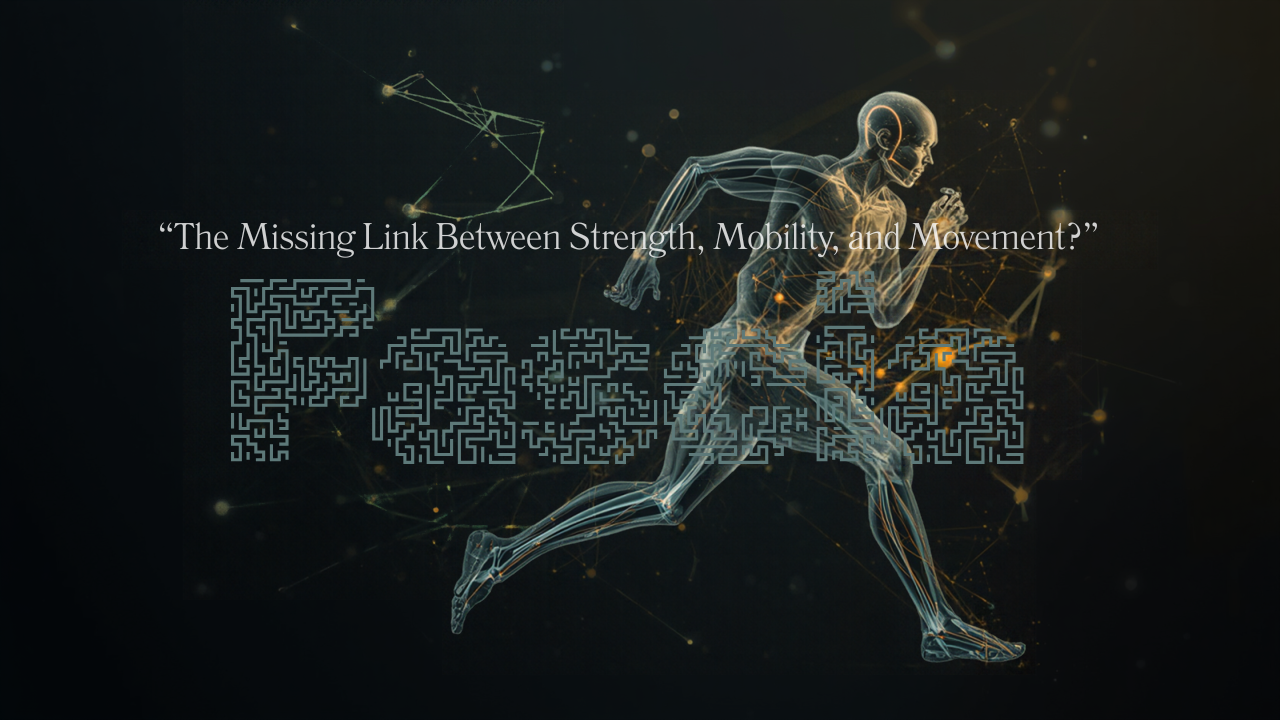
Your muscles may be where movement becomes visible, but beneath every repetition lies a quieter network helping your body organize, transmit, and respond to force. So how much of your performance is actually determined by the tissue you rarely think about?
There is something almost deceptive about human movement. When you perform a squat, your eyes see your legs bending and your muscles contracting. When you press a weight overhead, you see your shoulders and arms doing the work. When you sprint, you see the obvious power of your legs pushing against the ground. Yet none of these movements belong to a single muscle acting in isolation. Beneath the visible contraction is a continuous system of connective tissues, joints, nerves, tendons, and muscles interacting to produce movement.
Among those tissues is fascia, a complex network of connective tissue that surrounds and separates muscles, organs, nerves, blood vessels, and other structures throughout the body. It is not simply a thin wrapping around muscle, nor is it a mysterious substance responsible for every movement problem. Fascia is living tissue with structural and mechanical properties, and researchers increasingly recognize that it participates in the way forces are transmitted through the musculoskeletal system.
This is where the subject becomes particularly interesting. Fitness culture has transformed fascia into something approaching a celebrity tissue, with claims that it can explain stiffness, chronic pain, poor posture, limited mobility, athletic performance, and even the way your body “holds tension.” Some of these conversations are grounded in real physiology, while others stretch the evidence far beyond what science currently supports.
To understand fascia properly, we have to separate what is fascinating from what is proven.

The Body Is More Connected Than Your Workout Split Suggests
Traditional strength training often encourages us to think in individual muscles. We train the chest, then the back, then the legs, as though each muscle exists inside its own mechanical territory. This approach is useful for programming because muscles can be targeted and overloaded in relatively specific ways, but it does not perfectly describe how the body actually moves.
Fascia contributes to a continuous connective-tissue environment around and between muscles. Because connective tissues can transmit tension, force produced by one structure can influence neighboring structures under certain conditions. Research has demonstrated force transmission between some anatomically connected tissues, although the magnitude and functional importance of these effects vary depending on the tissues, movement, measurement methods, and individual anatomy.
This does not mean that performing a hamstring exercise somehow sends a magical wave of force through a predetermined “fascial line” into your neck. That interpretation would oversimplify a complicated biomechanical system. It means that the body cannot always be understood as a collection of completely independent mechanical units.
When you move, different tissues experience tension simultaneously, and the nervous system coordinates those structures according to the task. Fascia is part of that larger mechanical environment.
Strength Is Not Only About Muscle Size
When people talk about getting stronger, the conversation usually focuses on muscle growth, but strength is a more complicated phenomenon. Your ability to produce force depends on muscle cross-sectional area, neural drive, coordination, technique, leverage, joint position, training experience, and the ability of multiple tissues to cooperate efficiently.
Fascia does not replace muscle as the primary contractile tissue responsible for producing active force. Instead, its mechanical properties may influence how forces generated by muscles and transmitted through tendons are distributed across the body.
This distinction is important because the internet sometimes presents fascia as though it is a second muscular system hiding beneath the first. It is not. Fascia does not contract like skeletal muscle to perform your squat or bench press. Its importance comes from its structural and mechanical relationship with the tissues that do.
The more useful question is therefore not whether fascia creates strength independently, but whether the condition and organization of connective tissues influence how efficiently the forces produced by muscles are expressed through movement. The available evidence suggests that connective tissues can contribute to force transmission, but the precise contribution in living humans remains an area of ongoing research.
Why Mobility Is More Complicated Than “Tight Fascia”
Few words are used more casually in fitness than “tight.”
Someone cannot touch their toes, so they are told their fascia is tight. Someone struggles with a deep squat, and fascia is blamed again. Someone feels stiff after sitting at a desk, and suddenly the explanation becomes that their connective tissue has “stuck together.”
The human body is more complicated than that.
Range of motion is influenced by the structure of joints, muscle and tendon properties, nervous-system responses, previous injury, pain, training history, individual anatomy, and a person’s tolerance to stretching or movement. Fascia can contribute to the mechanical environment surrounding these structures, but it is rarely scientifically responsible to attribute every limitation in mobility to a single tissue.
This distinction becomes especially important when discussing foam rolling. Research consistently shows that foam rolling can produce short-term improvements in joint range of motion, and longer-term foam-rolling interventions can also improve range of motion in some circumstances. However, the mechanism is not as simple as physically “breaking up” or permanently stretching fascia.
In fact, research comparing foam rolling with stretching suggests that both approaches can improve range of motion, with neither being universally superior. That finding should make us cautious about the popular idea that every improvement following foam rolling proves that fascia has been mechanically released.
The body can become more mobile for several reasons, including changes in stretch tolerance, sensory input, muscle behavior, and other neurological and mechanical responses. Feeling less restricted after rolling does not necessarily mean that you physically reshaped a sheet of fascia.
What Are You Actually Doing When You Foam Roll?
The image is familiar. Someone finishes a workout, lies on a foam roller, finds a painful spot, and slowly rolls across it while believing they are breaking down scar tissue or releasing tightly bound fascia.
The experience can certainly feel dramatic, but sensation should not automatically be confused with structural transformation.
Systematic reviews have found that foam rolling can improve acute range of motion without producing meaningful declines in strength or power, which helps explain why it can be useful as part of a warm-up or mobility routine. However, evidence for large improvements in long-term athletic performance is considerably less convincing.
Research examining acute effects on myofascial tissue stiffness has also failed to provide a simple story in which foam rolling consistently produces major changes in the stiffness of fascia itself. One systematic review found that foam rolling did not clearly alter myofascial tissue stiffness or several measures of muscle strength, although the certainty of the evidence was limited.
This does not make foam rolling useless. It simply means we should describe its effects accurately. It may temporarily improve range of motion, alter how movement feels, reduce perceived soreness, and help someone prepare for activity. Those are meaningful outcomes even if the mechanism is not a dramatic physical “release” of fascia.
Fascia and the Experience of Pain
Fascia also intersects with one of the most complicated subjects in movement science: pain.
Connective tissues contain sensory structures, and the broader fascial system participates in the body’s sensory environment. However, pain is not simply a direct measurement of tissue damage. It is an experience produced by the nervous system through an interaction of sensory information, context, previous experiences, expectations, threat perception, and biological factors.
This helps explain why two people can experience similar physical sensations but interpret them very differently. It also explains why a treatment can sometimes make movement feel better without dramatically changing the underlying structure being treated.
The distinction is particularly relevant when someone describes a painful area as “knotted fascia.” The sensation may be real, but the explanation is not necessarily established simply because the area feels tight or tender.
Modern pain science increasingly encourages us to move away from single-tissue explanations and toward a broader understanding of how the nervous system interprets information from the entire body.

The Fascial Connection to Training
For someone who strength trains, the practical implication is not that every workout needs a complicated fascial routine. The more important lesson is that movement quality emerges from interaction.
A well-designed resistance-training program develops muscle strength and size, but it also exposes connective tissues to progressively increasing loads. Tendons, ligaments, bones, muscles, and other connective tissues adapt to mechanical demands over time. This is one reason progressive training should be introduced intelligently rather than treating every session as an opportunity to produce maximum fatigue.
Movement variety can also matter. Repeatedly performing one pattern may develop specific capacities while leaving other movement demands relatively unexplored. Incorporating different ranges of motion, movement patterns, tempos, loading strategies, and athletic tasks can expose the body to a broader range of mechanical experiences.
That does not mean constantly changing exercises is better than repeating them. Consistency remains essential for measuring progress. The goal is to provide enough repetition for adaptation while maintaining sufficient variation to develop a versatile movement system.
What Fascia Can Teach Us About the Body
Perhaps the most valuable lesson of fascia is that the human body cannot be fully understood by separating everything into individual parts.
The chest does not know that your workout spreadsheet calls today’s session “chest day.” Your shoulder does not operate independently of your rib cage. Your hip does not move without contributions from the pelvis, trunk, nervous system, and surrounding tissues. Every movement is an interaction between structures rather than a simple command issued to one muscle.
Fascia is part of that interconnected architecture.
Yet appreciating fascia does not require turning it into a miracle tissue. Science becomes more interesting, not less, when we acknowledge what remains uncertain. Researchers have evidence for connective-tissue force transmission and meaningful effects from interventions such as foam rolling, but many popular claims about “fascial lines,” permanent releases, detoxification, or dramatic structural changes remain considerably more speculative than social media suggests.
The responsible approach is therefore neither to ignore fascia nor to worship it. It is to understand its place within the larger system.
Final Verdict
Fascia is not the secret tissue that suddenly explains everything about strength, mobility, pain, or athletic performance. It is something more scientifically interesting: a complex connective-tissue network that participates in the architecture and mechanical behavior of the human body.
It can contribute to force transmission between neighboring structures, influence the mechanical environment around muscles and other tissues, and interact with the sensory systems involved in movement and bodily perception. At the same time, the magnitude and practical importance of many proposed fascial effects remain subjects of ongoing research.
For the person who trains, the lesson is simple but powerful. Build muscular strength, develop mobility, practice good movement, progressively expose your tissues to appropriate loads, recover adequately, and use tools such as foam rolling when they genuinely help you move or feel better. There is no need to turn every sensation into evidence of a fascial restriction.
The body is not a collection of disconnected muscles. It is an integrated mechanical and neurological system in which muscles, tendons, fascia, joints, bones, and the nervous system continuously communicate through movement.
Fascia may not be the missing piece that explains everything, but understanding it reminds us of something we often forget: strength is never produced by one tissue alone, and movement is always a conversation between many parts of the body.
Leave a Reply